

Chinese · Snack
Bak Kwa (Chinese Barbecue Pork Jerky)
From the zcook collection
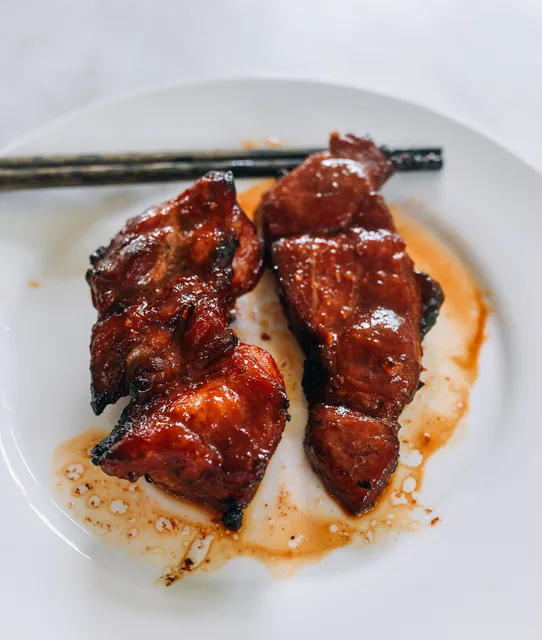
Thin sheets of seasoned minced pork, baked through and brushed with maltose before browning on both sides. Serve as a glossy, savoury-sweet snack.
- Dairy-free
- Chinese
- Snack
- bak kwa
- Chinese barbecue pork
- Prep
- 30 min
- Serves
- One batch of thin bak kwa pieces; the number depends on the tray loads and cutting size
- Level
- Hard
Method15 steps
Step 1: Pat the pork dry with clean kitchen paper and trim as needed. Cut into small pieces and mince finely in a food processor, or mince by hand. Keep raw pork and its utensils separate from cooked food.
Step 2: Put the minced pork in a mixing bowl. Add ¾ tsp salt, 80 g sugar and the 2 tbsp maltose reserved for the marinade. Mix thoroughly.
Step 3: Add the white pepper, Thai fish sauce (1 tsp), Shaoxing wine (1 tbsp), five-spice powder (⅛ tsp), oyster sauce (1 tbsp), light soy sauce (2 tbsp), dark soy sauce (1 tbsp) and sesame oil (1 tsp). Stir in one direction until the mixture becomes sticky and well combined.
Step 4: Cover and refrigerate at 4°C or colder for 8 hours, or overnight. Keep the mixture cold until you are ready to shape and cook it.
Step 5: Preheat the oven to 160°C. Line shallow baking trays with baking paper. A 35 × 18 cm tray is a useful size, but use enough tray area and oven loads to spread the mixture to 2 mm thick. Keep room in the refrigerator for uncooked sheets waiting to bake.
Step 6: Stir the cold marinated pork mixture thoroughly, then divide it into two equal groups. Work with the first half and keep the second half covered in the refrigerator. Keep any working mixture that is waiting for tray space refrigerated too.
Step 7: Lightly grease your hands with cooking oil. Spread the first half of the pork mixture onto the lined trays, distributing it over as much tray area as needed for thin sheets. Keep uncooked portions cold while you work.
Step 8: Cover the mixture with another sheet of baking paper and roll it evenly to about 2 mm thick. Remove the top paper. Refrigerate any shaped sheets that will not go straight into the oven.
Step 9: Bake one oven load at 160°C on the middle rack for about 15 minutes. Check from 15 minutes and continue until the ground pork is fully cooked and reaches 71°C/160°F at the centre. Keep the remaining uncooked sheets refrigerated. Cook the pork through before glazing and browning it.
Step 10: Lift out the baked sheets and cut into squares with scissors or a pizza cutter. Pieces around 4 inches across are a guide where the sheet size permits; smaller pieces are fine. Turn the oven to 240°C with top heat for browning.
Step 11: Dissolve the separate 2 tbsp glaze maltose in 1 tbsp hot water. Brush a thin layer onto the first face of the cooked pork pieces. Keep the remaining glaze in its bowl for the second face and later loads.
Step 12: Arrange the glazed pork pieces on a metal rack over a drip tray. Brown the first face under the oven top heat at 240°C for about 3–5 minutes, checking from 3 minutes. Watch constantly and stop when lightly charred and glossy; do not let the sugar burn.
Step 13: Turn the pieces and brush the second face with some of the remaining glaze. Brown that face under the top heat at 240°C for about 3–5 minutes, checking from 3 minutes and watching constantly, until glossy and lightly charred.
Step 14: Keep the finished pieces on a clean plate. Return the oven to 160°C and repeat the spreading, rolling, full baking, cutting, glazing and two-face browning in steps 7–13, using the one glaze batch prepared in step 11, for any remaining first-half sheets, then for the second half of the mixture. Keep all uncooked mixture and sheets refrigerated until their turn. Make every sheet about 2 mm thick, bake each load through to 71°C/160°F before browning, and use the remaining glaze as needed. Continue until all the pork mixture is cooked; the number of oven loads depends on your trays and oven.
Step 15: Serve the bak kwa freshly cooked. Refrigerate unserved pieces promptly in shallow covered containers at 4°C or colder, within 2 hours of cooking, or within 1 hour if the room is hotter than 32°C. Use refrigerated cooked pork within 3–4 days, or freeze it. Reheat stored pieces to 74°C/165°F before serving.
Photos (1)
Comments
0 threadsSign in to join the discussion.


No comments yet. Start the discussion.