
Korean · Side
Kimchi Recipe
From the zcook collection
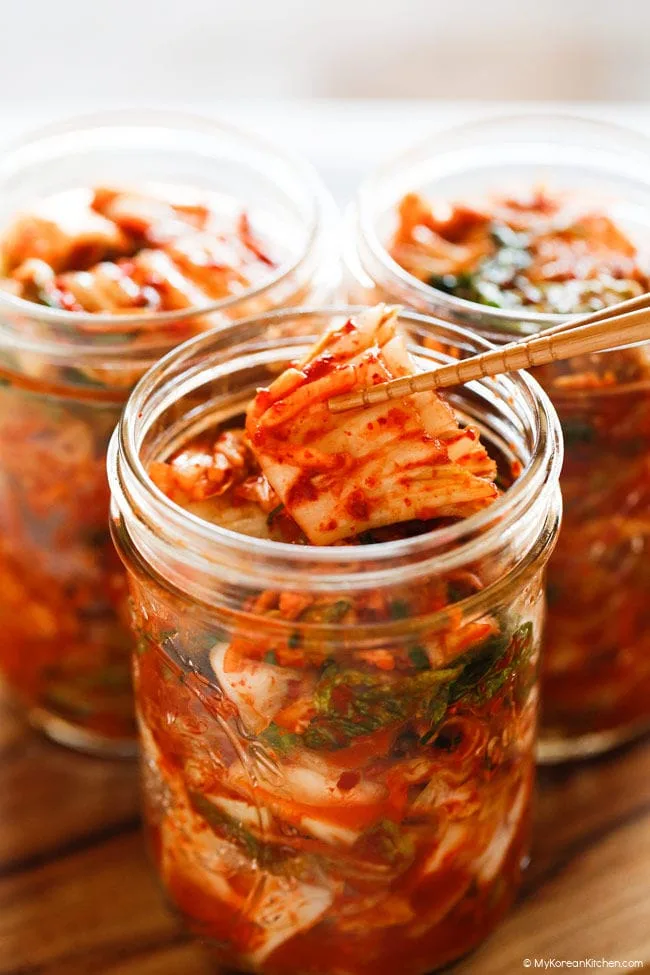
Whole-cabbage Korean kimchi yielding about 7 litres. Allow the source 8 1/2-hour brining and preparation guide, then 24 hours at room temperature and refrigeration. Another 3–4 refrigerated days develops more flavor.
- Dairy-free
- Korean
- Side
- Side dishes
- baechu kimchi
- kimchi
- napa cabbage kimchi
- Prep
- 2 hr 30 min
- Cook
- 8 min
- Serves
- About 7 litres
- Level
- Hard
Method14 steps
Step 1: Remove the thick outer cabbage leaves. Cut the napa cabbage (4 kg) into quarters, keeping each quarter attached at the stem, and rinse under running water.
Step 2: Dissolve 285 g coarse sea salt in 3840 ml brine water. Dip each cabbage quarter in this brine, then put it on a tray. Gently open the leaves and rub the medium-crystal cooking salt (97 g medium) over the thick white parts, using the 97 g total across all quarters. Keep the dipping brine for the next stage.
Step 3: Put the salted cabbage in a large food-grade bag or bucket with the wedge sides facing up, then pour over the reserved dipping brine. Close the bag, or use a weight to keep bucketed cabbage submerged. Begin a 6-hour brining period, turning at 2 hours and again at 4 hours. Leave for the first 2 hours now.
Step 4: After the first 2 hours, turn the cabbage upside down in the brine. Close the bag or replace the weight and leave for another 2 hours.
Step 5: After 4 hours total, turn the cabbage upside down again. Close the bag or replace the weight and leave for a final 2 hours, completing the 6-hour brining period.
Step 6: At the end of the total 6-hour brining period, remove the cabbage and discard the brine. Rinse under running water, especially between the thick white parts, to remove excess salt. Put the cabbage in a colander and drain for 1 hour.
Step 7: While the cabbage drains, mix the 2 Tbsp glutinous rice flour with the separate 360 ml paste water in a saucepan. Cook over medium heat for 5–8 minutes, stirring, until it thickens.
Step 8: Transfer the thickened rice paste to a bowl and let it cool. Only once cooled, mix in all the gochugaru (141 g).
Step 9: Mix the julienned radish with the separate tablespoon of fine sea salt (1 Tbsp), Korean fish sauce (3.5 Tbsp) and minced fermented shrimp (2 Tbsp). Leave for 10 minutes so the radish salts down. Keep this mixture and its liquid for the seasoning.
Step 10: Mix the salted radish mixture, including its liquid, with the Korean chives (90 g), julienned carrots (140 g), minced garlic (42 g), minced ginger (1/2 Tbsp), raw sugar (2 Tbsp), blended or grated onion (75 g) and cooled chili-rice-paste mixture. Mix thoroughly to make the kimchi seasoning.
Step 11: Put a drained cabbage quarter on a tray. Spread the prepared seasoning over one side of each leaf, leaving the leaves attached to the stem. Use about 1–2 small fistfuls per quarter as a guide; distribute the whole seasoning batch across all the cabbage quarters so you do not run out before the end. Repeat for all cabbage.
Step 12: Pack the seasoned cabbage into clean kimchi or airtight containers, filling each only about 70–80% to leave room for liquid and fermentation gas. Close the lids. Leave at room temperature for 24 hours, then proceed to refrigeration.
Step 13: After the 24-hour room-temperature fermentation, move the closed containers to the refrigerator. The kimchi can be eaten once chilled; leave it refrigerated for another 3–4 days if you prefer more developed flavor.
Step 14: Once chilled and ready to eat, cut only the portion you need and keep it in a smaller covered container for convenient serving. Keep the rest of the cabbage quarters intact in the main container and refrigerated at 3–5°C.
Photos (1)
Comments
0 threadsSign in to join the discussion.




No comments yet. Start the discussion.